Oenobareus

From the Greek meaning 'heavy with wine'
A blog devoted to science and reason
Written after a glass or two of Pinot Noir.
Showing posts with label physics. Show all posts

Monday, January 19, 2015

The Jazz of Teaching

Quite awhile ago, a former student suggested I write a piece on the physics of jazz. I decided not to, because a session with that title was scheduled at a then upcoming American Association of Physics Teachers national meeting. But his suggestion started me thinking.

I’ve listened to jazz for a long time. Take a look at my music collection, and it’s obvious I like jazz, and the more I thought about the student’s suggestion, the more I came to believe that I might be a jazz teacher; that is, I think I approach teaching the same way a jazz musician approaches music.

When I began teaching so many years ago, I always prepared lecture notes, but I’ve always encouraged questions from students. Today, I use notes for just one lecture a semester. That’s when I show students the solution to Schrödinger’s equation for the hydrogen atom. The math is too intricate to me not to use notes.

Duke Ellington Big Band
CREDIT: Unknown
I liken lecture notes to a musical score, but just because there’s a score, doesn’t mean a musician must play the notes as written. 

One of the oldest forms of jazz is swing.* When jazz was becoming more popular in the 1920s and became of mainstay of dance bands, it became necessary for arrangements to written down, but improvisation remained an integral part of the numbers.

Listen to Duke Ellington’s band play Diminuendo and Crescendo in Blue. Catch tenor sax player Paul Gonzales’s solo.


CREDIT: Columbia Records
Hard bop is probably my favorite form of jazz. Hard bob arose from bebop. In bebop, musicians improvise on the chords instead of the melody. With hard bop, there is usually a well-defined melody, many times a quite simple one. The rhythm section were released from keeping time.

What I usually do in class is come in with an idea of what I want to cover that period; that’s the melody. The depending on what students ask, I can deviate from that. Even get entirely away from the topic and discuss other related physics.

When it comes to hard bop, you can’t get any better than Miles Davis.

John Coltrane
CREDIT: Francis Wolff/
Mosaic Images — Corbis
Occasionally, I’ll come into the classroom, and students will start peppering me with questions. My favorite time. In my Physics 120 course, Physics For Everyday Use, I feel free to completely ditch my plan for the day. So when the students start throwing off-the-wall questions, I can go right off with them.

When you listen to avant garde jazz, you will have trouble differentiating what is composed and what is improvised. In fact, many listeners might not hear music; avant garde is an acquired taste. Listen to John Coltrane’s Ascension.


Jazz Professor.

* My source for the musical discussion is the All Musics Guide: The Definitive Guide to Jazz.

Saturday, August 16, 2014

The Impossible Is Still Impossible

I saw this article in Wired referenced on a couple of science pages on FaceBook. 

NASA validates 'impossible' space drive

Let me give you the short version of how this engine is supposed to work. Microwaves are beamed into a cone-shaped cavity. They bounce around the cavity and produce a force on the cavity in a direction perpendicular to the direction they were beamed in. Imagine  turning on the microwave oven and watching it push itself off the kitchen counter.

Why is it impossible? This violates one of the basic laws of physics. 

The Conservation of Momentum

The conservation of momentum isn’t your ordinary law of physics. It is one of the most fundamental principles in science. It is intimately related to spatial symmetry. Roughly speaking, the laws of physics here are the same there. You may know this as Newton’s third law of motion or for every action, there’s an equal but opposite reaction.

To obey the conservation of momentum, propellent is pushed out by the rocket and the rocket is pushed by the propellent. This engine is said to produce thrust without any propellent. 

So I was immediately skeptical. So I dug around a little bit. I found a short description of the experiment. One thing I found interesting is that the authors did not lecture on “”physics of the quantum vacuum plasma thruster.” All right, that’s fine; if the results were groundbreaking, the explanation might come later. Something similar happened in 1986. Researchers at IBM discovered ceramic materials that lost all electrical resistance (superconductivity) at surprisingly high temperatures. There is still no complete explanation for why this happens. What is different about these two cases is that the superconductivity ceramics didn’t violate any basic principles of physics.

What made me laugh however is the authors claim that their device may be “demonstrating an interaction with the quantum vacuum virtual plasma.” I have no idea what they mean by a quantum vacuum virtual plasma. 

I also found their paper. This made me giggle, too. They built two devices: one was designed to work, the other was designed not to work. Both versions produced the same amounts of thrust.

Phil Plait in his Bad Astronomy blog at Slate says this episode is reminiscent of the faster than light neutrinos and the mysterious force slowing down the Pioneer spacecrafts.

It reminded me of an article that caught my attention while I was in grad school. I remember getting all excited about this revolutionary paper published in one of the premier physics journals. The authors had data that showed that a gyroscope rotating in one direction weighed less than if it were rotating in the opposite direction. Finally, an anti-gravity device!

My research advisor wasn’t nearly as excited. His comment was something along the lines of “systematic error.” But still I held out hope.

Then four months later, my anti-gravity hope were dashed. Others trying to replicate the results found there is no anti-gravity.

Sunday, August 10, 2014

KCAL 9 And The Supermoon

CREDIT: CBS
I was watching the KCAL 9 news at 10 p.m. They had a report on the super moon. (yawn)

But then Serene Branson said this:
And they say that with the full moon like that, that if you’re feeling a little tired, a little sluggish, that it’s because of the pull. Just like how the moon has an effect on the tides, it has an effect on us, because we’re mostly water. And that’s when the crazies come out.

Despite what Bill O’Reilly thinks, the tides have a well-known cause. The tides are due to the difference in the strength of the gravitational force on opposite sides of the earth. 

There is no measurable effect on the moon’s gravitational field on us. UCLA astronomer George Abell calculated that a mosquito on your arm would exert a greater gravitational force on you than the moon.

As to the supposed lunar lunacy, that too was debunked long ago. 

I thought that maybe KCAL meteorologist Amber Lee might correct her, but no. That got me to thinking about Lee’s credentials. She has a bachelor’s degree in communications and a master’s in journalism. No degree but a certificate in  meteorology through Mississippi State University’s Broadcast Meteorology Program. To earn this certificate, she had to pass an online exam consisting of 100 multiple choice questions. 

Thursday, March 27, 2014

To Brian DeFacio

All of the professors in the physics department at the University of Missouri had a substantial impact on who and what I am. Three, however, deserve special mention, because they had an outsized influence on me both as the physicist and teacher that I am.

David Cowan, my research advisor, taught me to see science as one big picture. Henry White demonstrated much confidence and a lot of patience in a graduate student and allowed me to be one of the first two graduate students to teach an undergraduate course.

Brian DeFacio. I could always count on him for a conversation. In my acknowledgment section of my dissertation, I included a joke that that only those who knew Brian will get. 
I thank Dr. Brian DeFacio for innumerable conversations.
These never occurred in his office. Sometimes in the hallway, sometimes before or after class, but usually in the physics department lounge. Breaking news in physics? Brian would be all too happy to discuss it with you. An interesting problem in a course? He wouldn’t necessarily help you with it, but he would put his own special spin on it. 

Sometimes he would relate personal stories. A favorite - Brian was serving in the armed forces, Army I think, and stationed at a Nike missile facility. There was this young lieutenant who didn’t think too highly of Brian and often pulled rank. Brian was on guard duty one night when this officer came by his post. Brian challenged him, and the officer did not respond with the correct counter phrase. He then ordered the officer onto the ground and held him at gun point until others arrived.

What you should take from this story is how he treated people. Brian always treated us grad students as colleagues. He never used his position as anything other than teacher, mentor, and friend.

In the classroom, he was a wonder. No one could fill a blackboard like him. Room 305 held at most eighteen people, and it had boards on three walls. Brian would start at the front on the left, and after half an hour would reach his starting point, and we would then start the next lap. I remember inventing a DeFacio dictionary that I kept in my head. Note taking because much easier. So when I wrote “linear, isotropic, and homogeneous,” I just thought something like “the usual case.”

One day, halfway through the lecture, someone caught a sign error. After correcting it, he told my favorite story of one night while working at home, his wife asked him if something was wrong. Brian said that he was trying to find a missing minus sign. She asked him why don’t you ever try to find a missing plus sign.

Brian also had a way of making you come up to his standards. I was in his Condensed Matter I course. We had two homework assignments and a final exam. I didn’t do every well on the first homework set, but I did all right on the second. I missed one class that semester. He saw me the next day and said I had missed the best lecture he ever gave, one on Anderson localization.

When the final came along, there were two facts of life. Because I did poorly on the first homework, I had to do well, and I had to know Anderson localization. I nailed that test. Perfect answer on Anderson localization. After checking with some classmates, I suspected I had the highest score on the final. So I was a little miffed when Brian gave me a B, but that lasted about 30 seconds, because he was right. I blew off the first assignment; he knew it, and I knew it. He wanted us to do the best we could at all times.

Toward the end of my comprehensive exam, Brian raised his hand to ask a question. Now I was prepared for this exam. I knew my research topic. I could have answered nearly anything the committee could throw at me. So what did he ask? 
Calculate the power output of a fly.
I haven’t seen or spoken to Brian in twenty years. Now there are no more opportunities for discussions, but in a way, that’s okay, because of all those conversations that were too many to count.

Monday, December 23, 2013

Grandma Got Run Over By A Reindeer

Remember this Christmas song?
Grandma got run over by a reindeer
Walking home from our house Christmas eve
You can say there's no such thing as Santa
But as for me and Grandpa, we believe 
She'd been drinkin' too much egg nog
And we'd begged her not to go
But she'd left her medication
So she stumbled out the door into the snow 
When they found her Christmas mornin'
At the scene of the attack
There were hoof prints on her forehead
And incriminatin' Claus marks on her back

So I got to thinking. What would happen in a collision between a reindeer and an elderly woman.

While the song seems to imply that Grandma may have already been lying drunk in the snow and was then trampled by the reindeer, I’ll assume a more violent interaction. She was walking, and the reindeer, running down the road, hit her from behind.
Typical Diagram Drawn by a Physicist
The physics here involves the conservation of momentum. To simplify the problem, I’ll assume that the collision is like the one between billiard balls, what a physicist calls an elastic collision.

Momentum is the product of an object’s mass and its velocity.
A fundamental principle of the universe is that momentum is conserved; that is, this quantity of motion doesn’t change. It is mathematically expressed like this.
In collisions like ones with billiard balls, the total kinetic energy also is constant.
Let’s suppose this reindeer weighs 400 lbs. and was running at a speed of 45 mph. Let’s also suppose Grandma weighs 110 pounds and was walking at 4 mph.

With a bit of algebra we can find what happens to Grandma. It ain’t pretty. Grandma flies forward with a speed of almost 70 mph.
CREDIT: coolthings
Now about this family that let’s an old woman drink too much and then let’s her trudge all alone through the snow. 

Sunday, October 27, 2013

What Does a Physics Degree Get You?

Free food.

I woke up yesterday, and as I do everyday, I checked my email. There I saw that I had been tagged on FaceBook by Steve, a relative of mine. He posted the following:
Need some help from my academia family and friends! I need to present "in layman terms" how cold it would have to be outside to freeze 2 gallons of water @ -19ºC. 
Background: The product I sell has a moisture cured urethane in it and is activated by water. I am working in Canada where the lowest ever temp recorded was -60ºC (1947) so how long would it take to freeze a 2 gallon sprayer of room temp water which is about 10ºC at -19ºC. 
1st person that can explain it (so my block head can understand it) win's a perfectly smoked brisket delivered or shipped to "His or Her" home!!
Now he posted this at 5 am (7am Texas time), and I was still blissfully asleep. One and a half hours later, he wrote
So far my simple question is still unanswered! (Tick Tock) BTW when the west coast awakens my family physicist Vann Priest will have no problem with this so you all had better hurry!!
CREDIT: Steve
By the time I awoke at 8:30, Steve had already gotten some really good answers from Brian and Karen, so I was afraid I lost a chance at some Texas smoked brisket. I should make clear that Steve has this awful habit of posting his BBQ on FaceBook, and whenever he does, I drool all over my shirt. However, since he didn’t yet award it officially, I figured I might still have a chance.

CREDIT: Steve
A brief shout-out to Kevin who is quite an accomplished smoker. Kevin's brisket is also scrumdiddlyumptious, and I have been privileged to taste it on several occasions. It might be awhile before Kevin or I get another brisket though. He just became the father of twin boys.

So here’s my answer.

First the water has to cool to 0ºC. Newton’s law of cooling states that the rate at which the temperature of an object changes is proportional to the difference in temperature between the object and the environment. Fancy way of saying that if you want to cool something off really quickly, you put it in the refrigerator; if not, leave it in the kitchen.

Mathematically, Newton’s law is written

T is the temperature, t is time, TE is the temperature of the environment, and k is some constant. This is a straightforward first order differential equation.  The solution is

The problem though is that to find the time t we need to know both constants, k and C. There’s a lot of complicated physics that goes into k and C; however, to find C, we can set the time equal to zero. We know the initial temperature of the water and the environmental temperature. Punching a few numbers into my handy calculator gives me 3.37. We could do something similar to find k, but we would need to know the temperature of the water sometime later. I don’t have that information, so I can’t find the time it takes to cool down to freezing.

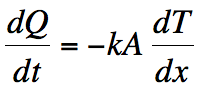
I’m not going to let that stop the analysis though. Once the water reaches 0ºC, it begins to turn into ice. The temperature stays at zero until all the water freezes. We can find how long it takes by knowing that the energy transfer happens by thermal conduction. Here’s the equation governing this phenomenon.

Q is the amount of energy that is being transferred (usually called heat), t is again the time, T is the temperature of the object through which the energy is being transferred, and x refers to the thickness of the object. There are two constants here too. A is the cross-sectional area of the object, and k (a different k) is called the thermal conductivity. (Once again, a lot of complicated physics rolled into a single number).

Here is a major complication. I can look up the thermal conductivity and figure out the area and the thickness.  The total amount of energy transferred in so problem; Q = mL where m is the mass of the water and L is the amount of energy required to change the state of the water per kilogram. But this differential equation is for one dimension only.  To do it in all three directions is some tough mathematics.

There’s no easy way to solve Steve’s problem.

Or is there?

I’m an experimental physicist. Let’s do the experiment. The freezer in most refrigerators is about -19ºC. Let’s put one gallon of water in the freezer and see how long it takes. The time it takes for 2 gal will be about twice as long.

Two hours into the experiment and the first thin layer of ice begins to form. In another hour, there’s a significant amount of ice. So Steve has about four hours before he needs to worry, and a Texas smoked brisket is on its way to California.

Monday, September 9, 2013

Why I Love/Hate Web 2.0


From the time I was born until I was about 16, my father owned a burger joint.  The Castle Burger. He opened every day at 11 am. For many of those years, I remember the local dentist, a nightclub owner, and two other men would take a booth and drink coffee for an hour or so.  They would sit there, sip on the coffee, and talk about current events.

That’s how much social commentary happened. Over a cup of coffee, a glass of beer, at the dinner table. Unbeknownst to everyone at the time that began to change in 1993.

That’s when the European particle physics lab, CERN, gave the world the World Wide Web.

I joined the Internet in the fall of 1994, and I created my first web page shortly thereafter. To do that, I learned some basic html at an American Association of Physics Teachers workshop and taught myself more advanced coding by examining the source code of pages I liked. Web page production became a hobby, and I changed the look of my pages almost annually – just because I could.

One had to be technically literate to create a page, or one had to have the money to have one created. The information was static and flowed one way – from the content creator to the viewer. For the most part, I think the Internet shared whatever credibility more established media enjoyed.

Then sometimes in the 2000s, the Web changed. We now had Web 2.0. Users became content creators without having to bother creating a web page.

Everyone could now contribute. MySpace and Facebook allows us to easily stay in touch; Wikipedia makes it easier for experts to share their knowledge; Tumblr, WordPress, and Blogger make it simple for anyone to share their thoughts.

The true democratization of the Internet.

I joined this democracy movement in April 2010. I created my FaceBook profile. I was motivated by my desire to reach out to my students at Rio Hondo College. I tell them what I think of them - they are the best students at Rio Hondo and they will be the best students at whatever university or college they transfer to, but despite their obvious interest and perhaps because of the times, they are not always aware of the scientific, engineering, and technological advances being made everyday.  I thought that I could do something to sneak in some learning.

Then I got a bit bored in July 2011. So one afternoon I signed into Blogger and started Oenobareus, my blog dedicated to science and reason written after a glass or two of Pinot Noir.

That is what I love. Both the blog and FaceBook let me share what interests me, and my expertise. Plus they give me a creative outlet. I try to be informative, occasionally funny, and every once in while, I let out some righteous anger.

Let me share some of my favorite blog posts:
Transformers 3 - Dark ofthe Moon: I applied some basic physics to calculate the gravitational effects of Cybertron on the Earth.
Don’t Ask Marilyn - parts 1 through 4: Marilyn vos Savant is a columnist in Parade magazine. In a 2011 column, she defends herself against a math teacher in a problem in probability. The post prompted several emails and three other posts where I patiently explain probability and entropy.
Santa Claus Science: Did you know it takes 11 million reindeer to pull Santa’s sleigh?
Flying Aircraft Carriers:Physics and Engineering in The Avengers: Another piece inspired by a movie. What I really enjoy about this piece is that I hope that students (and others) realize how one can do a quick calculation without sophisticated theories.
July 4th isHiggsdependence Day: Announcing the discovery of the Higgs boson. This was particularly fun as I have a brother-in-law named Higgs.
Twas the Night Before What?: A Newtonian twist on Clement Moore’s poem.
Au-some: There were many reports in the press how scientists had discovered the nuclear process by which gold was created. What I like about this one is I really had to delve into the literature. Nowhere in the article was gold mentioned.
These are some of my favorites, because I was sharing my expertise.

Why do I hate Web 2.0?

It all started late in 2011. I received a friend request from Aaron, an acquaintance of a former student. He stated he was interested in intellectual discussions. As it turned out he was a libertarian, anarchist, christian, young earth creationist.

I made a smart-ass comment about Bristol Palin when Aaron asked how to end teen pregnancy. That led to me educating myself on the issue and my post Making Babies. Which led to You keep using that word. I do not think it means what you think it means.

And thus began my intense dislike for Web 2.0.

Through Aaron I found True Dinos, a Facebook profile of a Texas fellow who like dinosaurs. This young earth creationist (YEC) witnessed a pterosaur when he was 11 years old.

It was at True Dinos that I ran across Cowboy Bob Sorensen and The Question Evolution Project.

Here’s what you need to know about TQEP:

Welcome to "The Question Evolution Project". This is a resource that points to information showing the failings of evolution. We are also here to encourage people to speak out against evolutionary indoctrination.

Evolutionism dominates the media, education and so on. Pages like this are "equal time" to present information that is ignored and often suppressed. We attempt to help raise awareness that true science is not afraid to examine contrary evidence and allows alternative theories to the interpretation of the evidence (such as creation science). Specifically, evolutionists should not have the right to shout down, censor, censure or intimidate creationists / ID proponents.

I first earned the ire of Cowboy Bob, a biblical literalist, by insisting he confront his hypocrisy. I asked him if he was a geocentrist. Bob blustered about suing me for posting screenshots from FaceBook.

I mocked Bob after that by finding a photo of him and attaching this description: “Bob has read one book. It has made him an expert in biology, geology, physics, and chemistry.” Nine months later, Bob filed a Digital Millenium Copyright Act complaint and the photo was removed from FaceBook. But not for long.  I filed a counter-notification and a few weeks later, access was restored.

Another character is Kirk Hastings. Kirk has a few FaceBook profiles: What is Truth?, Freedom From Atheistic Scientism, and The Question Irreligiosophy Project. Kirk has a habit of pasting quotes. I came across one that I had to investigate.
Radio telescopes, linked with computers, simultaneously search millions of radio frequencies for a nonrandom, nonnatural, extraterrestrial signal—any short sequence of information. Yet, the long sequence of information in the DNA of every living thing on Earth is a signal from an intelligence—a vast intelligence—a Creator. Almost all those searching for extraterrestrial life believe it evolved naturally in outer space. If they ever accepted the DNA evidence for a Creator, the evolutionary basis for their search would disappear.
He credits a journalist for the journal Science and helpfully cites the volume, date, and page number.

I downloaded the article and searched for the quote. Even after calling him out for his dishonesty, he continued to claim that he was accurately quoting the journalist and insisted the quote from the very article I had in my hand. Only very recently has he deleted the post from his timeline. I’ll take that as an admission of guilt.

There is no shortage of creationists to joust with. There are also plenty of cranks out there who are willing to engage. Stupid politicians will continue to provide comedy gold as well as provoke anger.

But I reserve a special enmity for commenters. Even before Web 2.0, I never understood call-in radio shows, interviews with the person on the street, and the like.

Commenting seems to bring out the very worst especially behind a wall of anonymity. Just this past Friday night, the CBS affiliate aired a story that hits me rather personally.

For thirteen years – up to 2011 – I worked with students and teachers at a private elementary school. I coordinated the science program, developed science lessons with the teachers, and taught all levels from pre-school to 8th grade. Until you’ve been in a classroom with these teachers, it’s hard to appreciate the job they choose to do.

So it was with deep sadness that I read this story. If true, a teacher violated the trust of a student, the parents and his co-workers.  If false, a man’s career is sidelined and his reputation is ruined. The article states that the teacher is forbidden by the California Department of Social Services from having any contact with any children in any facility licensed by the department. The Whittier police department closed its investigation and the District Attorney is not filing any charges

Let me read you some of the 863 comments [as of 9:20 am, Sept. 8.] These are not necessarily the worst of them.
  • Should have identified the despicable deviant teacher by name.
Typical MSM and Union rats at work.
  • Oh good, another liberal sicko exercising its uninvited deviant sexual desires on others, and once again, on a child. When liberals are not busy murdering children, or making it easier for others to murder children, they are busy molesting the children. They call it, "being progressive".
  • No wonder he got in trouble...
He didn't say "Obama says".
  • KILL the perv!
  • On one hand you have the government brainwashing your children with communist ideologies and on the other hand they are being molested by these freaks. If god doesn't deal with these vermin then the people will. Soon. VERY soon.
  • Another liberal pedophile who we have teaching our kids.He needs to be swinging from a tree at the end of a rope.
  • sounds like black to me.
  •  If I remember correctly, all pedophile teachers are sent to Kalifornia to teach. Kalifornia does not discriminate based on sexual preference. The zoophiles are sent there as well. What a wonderful inclusive place to raise a family.
  • Not only are the Public School "teachers" Lefty Lemmings but they are also Pedophiles.
  • I've never known a male to work as a preschool teacher.
  • If it were a male of European decent or a Christian of any decent they would have blasted the face and name everywhere. I am gonna bet it was either a homosexual or a minority.
  • Its now open season on Johnny's fartbox. Homosexual Sodomite Pedophiles are going to be raping children all over this nation this school year. You get what you voted for.
  • only anal tongue darts are acceptable in California

And with that, thank you for letting me get all this off my chest.

Thursday, August 8, 2013

Au-some!


This past month there have been numerous stories about how all the gold in the universe was created.  Just google "gold neutron star", and you'll see what I mean. So being me, I wanted to read the original research: An R-Process Kilonova Associated with the Short-Hard GRB 130603B, E. Berger, W. Fong, and R. Chornock of the Harvard-Smithsonian Center for Astrophysics. (1)

I first gave it a cursory read. I couldn't find a mention of the creation of gold anywhere, so I took advantage of technology and used the Find command in my browser. Nothing there, but then I realized why. Someone at Harvard must have written a press release, and in order to get the media interested in the research - which is legitimately important - they  made it sexy and what is sexier than gold.

So I sat down to read the kilonova paper carefully. I didn't have to read far before I read the phrase r-process and Justin Huang's graduate level nuclear physics class came to mind. [Although r-process is in the title, my mind didn't click in until later.]

First some background for those of you not nuclear or astrophysicists. After a microsecond, protons and neutrons formed and couple of minutes or so later, the universe had cooled enough for primordial deuterium, and helium nuclei to form.  Many years later, 379,000 actually, electrons combined with these nuclei to form atoms. It wasn't until a hundred or so million years that stars began to shine.
CREDIT: Atmospheric Imaging Assembly (AIA 304)
of NASA's Solar Dynamics Observatory (SDO)

Fred Hoyle and his colleagues in a classic paper (2) showed how the elements other than hydrogen and the primordial helium were created. I won't go into a long explanation of stellar evolution, but the elements up to iron were created by nuclear fusion. The Sun is fusing two hydrogen nuclei into a helium nucleus and this process releases a lot of energy (we call it sunshine). I'm oversimplifying here, but when the hydrogen in our Sun is depleted in about 5 billion years, it will start to fuse helium. When the helium is gone, our star will be a very hot ball of carbon and oxygen. The Sun will be a white dwarf - basically a very large and very hot diamond in the sky. 

Stars more massive than the Sun will keep fusing and shining up to the point where iron is formed. The process stops there because to fuse iron and elements heavier than it requires an input of energy.

If you now look at a periodic table, you should wonder where did all the other elements like gold come from. There are two processes that are responsible for these heavy elements: the r (rapid) and s (slow) processes. The s-process cannot create elements heavier than lead and this method occurs in old giant stars. 
The Periodic Table of the Elements with hydrogen, helium, iron, and gold highlighted.
Hoyle et al. suggested that the r-process occurred in type II supernovae. This sort of supernova comes about when the thermal motion of the nuclei is not enough to counteract the effect of the star's self-gravity. The core of the star collapses and the outer layers are violently ejected. Depending on the initial mass of the star, the result of the core collapse is either a neutron star or a black hole.

The problem with this hypothesis is that given the abundance of the elements either most supernovae did not expel much matter or that supernovae ejects only a small amount of the material. Given the intensity of a type II supernova, either possibility seems unlikely.
The Crab Nebula, the aftermath of a supernova.
CREDIT: NASA/ESA
One possibility was the collision of neutron stars (3), and here we're back to the kilonova paper. Berger and his co-workers present evidence of "the presence of excess near-IR emission matching the expected brightness and color of an r-process powered transient (a kilonova)" and the inferred mass ejected during the collision "matches the expectations from numerical [neutron star] merger simulations."

My head exploding.
CREDIT: Gil Thorpe
Look at that ring on your finger or the chain around your neck. Then imagine two neutron stars colliding. 

References:
(1) An R-Process Kilonova Associated with the Short-Hard GRB 130603B, E. Berger, W. Fong, and R. Chornock, http://arxiv.org/abs/1306.3960v2.
(2) Synthesis of the Elements in Stars, E.M. Burbridge, G.R. Burbidge, W.A. Fowler, and F. Hoyle, Reviews of Modern Physics, Vol. 29, No. 4, pp. 547 - 650 (1957).
(3) R-Process in Neutron Star Mergers, C. Freiburghaus, S. Rosswog, and F.K. Thielemann, The Astrophysical Journal, Vol. 525, No. 2, pp. L121-L124 (1999)

The United States Bullion Depository, Fort Knox, KY, shown here in a scene from the James Bond movie Goldfinger.
CREDIT: United Artists/Eon Productions